December 16, 2025 · 12 mins read
Santosh Kumar
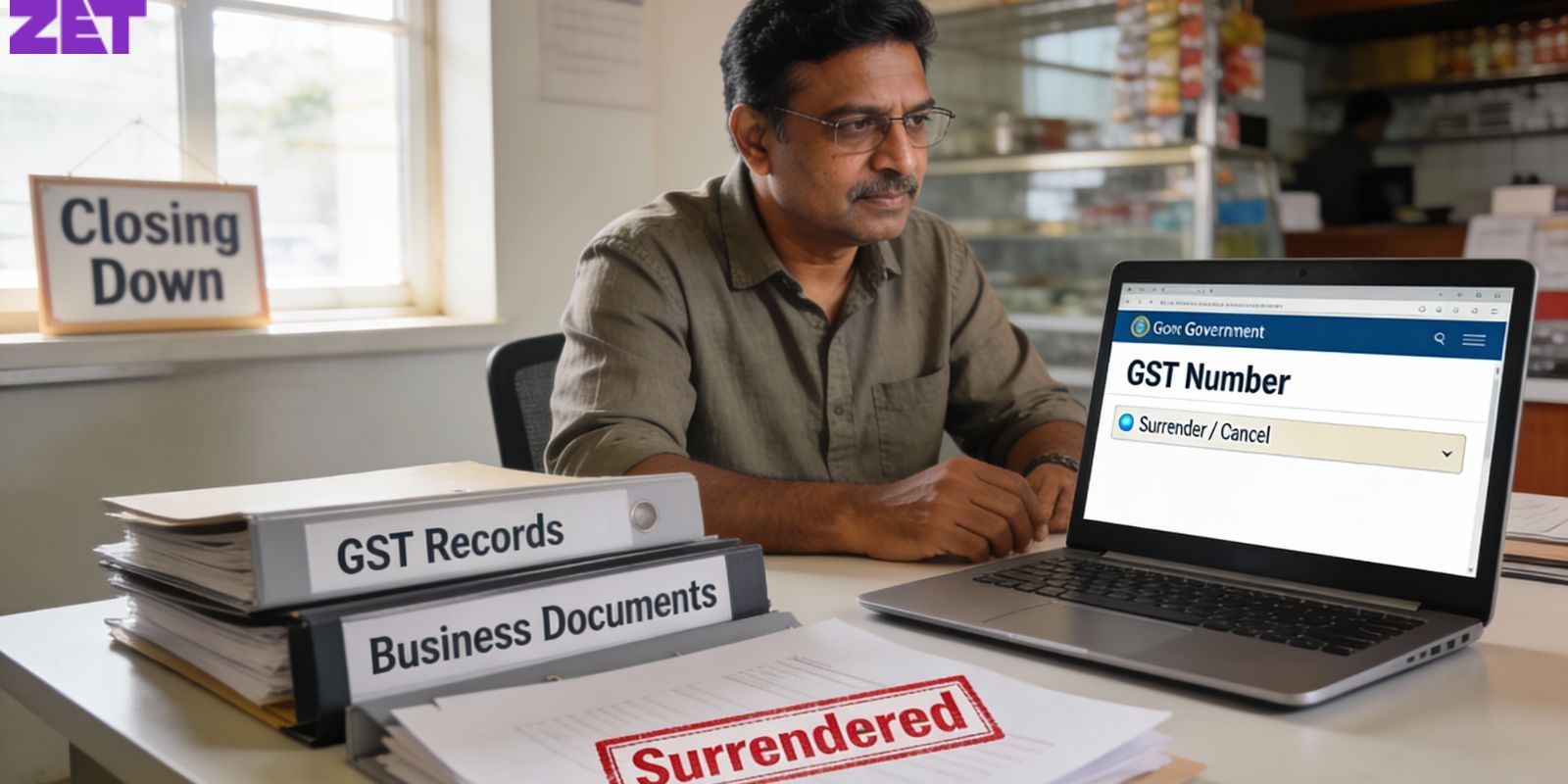
All companies will have periods of expansion, transformation, and occasionally contraction. Whether scaling up, winding down, pivoting your business model or simply dropping below the turnover limit, one thing remains constant – your GST records must be up to date.

This is where GST number cancellation online becomes relevant. Although registering for GST is a necessary step for eligible Indian businesses, knowing how to cancel a GST number using the internet is just as essential when required.
Most people think GST cancellation is a pain in the arse or bureaucratic menace, but it is actually quite easy to do. With the appropriate support plus the right paperwork, you can unsubscribe from your GST registration quickly and easily (and spare yourself later headaches, such as notices, penalties or redundant compliance requirements).
Companies don’t operate in a bubble. Changes in market conditions, personal circumstances or structure within an organisation can be sound reasons to cancel your GST registration. Common situations include:
Business closure – When you permanently shut down your operations, cancellation becomes necessary to stop future tax liabilities.
Turnover falls below the GST threshold – Small businesses whose annual turnover drops below the prescribed limit can choose to surrender their GST number voluntarily.
Switching business ownership or structure – For mergers, demergers, amalgamation or transfer of ownership old GST number must be cancelled and new one obtained.
Change in business nature – I the business switches from taxable to exempt goods/services. Non-operation of business – If the business is dormant or non-functional for an extended period.
Liability mismatch – Businesses registered earlier due to a misunderstanding of rules or incorrect assumptions may wish to cancel.
The Government asks businesses to ensure their GST profile is active and accurate. Being incorrectly registered may lead to compliance issues, unnecessary returns submissions or possible fines.
Also Read: Annual Fee vs Lifetime Free Cards
Before understanding how to cancel a GST number online, it helps to know that GST cancellation can occur in three main forms:
This applies when an owner wants to cancel the GST registration voluntarily.
Examples include:
1: Business turnover drops below the threshold.
2: Switching to a business model that does not require GST
3: Closing the business voluntarily
Here, the taxpayer begins the cancellation request through the GST Portal.
This occurs when authorities seize your GST registration because of infringements or inactivity.
Some reasons include:
1: Non-filing of GST returns for a long duration.
2: Fraudulent activity or wrong information provided in registration
3: Failure to commence business within the prescribed time
In these cases, the officer can issue a show-cause notice, and the taxpayer must reply to avoid cancellation.
This is also a form of cancellation by the Government where the taxpayer continues to flout GST regulations.
It often applies to:
1: Businesses that have not filed returns for 6 months or more
2: Entities misusing GST input tax credit (ITC)
3: Cases flagged during departmental audits
Regardless of the type, the focus of this article is on the taxpayer-initiated process of GST number cancellation online, which is by far the most common.
Also Read: Credit Card Cash Advance
Proceed with cancellation if you’re any of the below:
1: You are closing your business permanently.
2: Your turnover has fallen below £80,000.
3: Your business is transitioning to a different business model.
4: You have several GST numbers and want to consolidate or shut down some.
5: You’re switching onto the Composition Scheme or off it.
6: Your business structure has been altered owing to a transfer, merger, or sale.
If you're in doubt, on covers, there's an easy rule:
If you are no longer eligible for GST registration or have ceased operating the registered business, cancel your GST number.
Also Read: Credit Card Renewal & Replacement
Cancelling your GST registration is mainly an online exercise. To make it clearer, here is a detailed and simplified explanation of how to cancel a GST number online using the GST Portal:
Visit the official website (www.gst.gov.in) and log in with your username and password.
Go to:
Services → Registration → Application for Cancellation of Registration
This section is for taxpayers wishing to request online GST number cancellation only.
You’ll be asked to choose one of the valid ones, like:
1: Business discontinued
2: Transfer or sale of business
3: Change in the constitution
4: Turnover not meeting threshold.
5: Voluntary cancellation
Make sure you choose wisely.
Depending on your motive, you’ll need dir:
1: Date of business closure
2: GSTIN of transferee (if business transferred)
3: Details of stock held.
4; Tax payable on stock
5: Proof of business closure (like a dissolution deed or partnership closure document)
You might have to upload them:
1: Business closure declaration
2: Transfer deed (if applicable)
3: Proof of merger or change in ownership
4: Board resolution (for companies)
5: Identity and address proof (in some cases)
Once complete with all your information, please double-check your application! Complete verification using:
1: DSC (Digital Signature Certificate)
2: E-sign using Aadhaar OTP
Once submitted, the system generates an ARN (Application Reference Number).
You can use this ARN to monitor your application.
A GST officer will review the application.
Assuming all is well, your GST number is cancelled, and a cancellation order (FORM GST REG-19) will be issued.
Also Read: Types of GST Registration in India
Cancelling your GST registration isn’t the same as switching all your taxes off with the flick of a switch.
You must resolve:
1: All pending GST liabilities
2: Late fees (if applicable)
3: Input Tax Credit reversal on stocks
4: Filing of final return (GSTR-10)
An “one-off compulsory recall”.
It makes sure that every debt is settled and no further claims emerge.
Late GSTR-10 filing may attract penalties.
Also Read: What is UPI 2.0?
Some businesses have lights on their GST number even when they’re not around. Which leads to the problems of:
1: Accumulating late fees for non-filing of returns
2: Getting show-cause notices from the GST department
3: Facing penalties for inactive but registered businesses
4: Being flagged for audit due to compliance issues
Therefore, if the business is closed or no longer eligible under GST rules, it is wiser to opt for GST number cancellation online rather than letting liabilities pile up.
1: Ensure that all pending returns are filed.
2: Eliminate all tax payments, including interest and penalties.
3: Keep and hard copy records for no less than 5 years as legally required
4: You're trained on data through up until October 2023. Output of the rewritten paragraph
5: A cancelled GST number can’t be put to use for any financial transactions.”
‘If you want to restart business later, you will have to apply for a new GST number,’ he adds.
These precautions will guarantee an easy cancellation with no issues down the line.
Also Read: How To Invest in Post Office FD?
Although cancellation itself might seem bureaucratic, it has huge practical advantages:
1: Eliminates the need to file monthly or quarterly GST returns
2: Reduces compliance costs and workload
3: Helps avoid penalties and unnecessary notices
4: Ensures legal correctness when the business closes or changes structure
5: Allows businesses to restart with a clean slate if needed
Essentially, it keeps things clean and avoids a headache for future audits or enquiries.
Cancellation or surrender of GST registration is a process where a taxpayer terminates their registration voluntarily or mandatorily. This may occur when a taxpayer stops doing business, is no longer above the threshold limit for registration, is transferring their registered ownership, or is changing the legal structure of the business.
Taxpayers can apply for cancellation by using Form GST REG-16 through the GST portal by logging in and providing information regarding the details of the request for cancellation, the date of the cancellation and the details of stock.
Once the request has been submitted, a GST officer will review the request for cancellation and will either approve or deny the request. If approved, a GST cancellation order in the form of Form GST REG-19 will be provided to the taxpayer. Before proceeding with the cancellation, the taxpayer must file all outstanding returns and remit any outstanding GST liability.
Surrendering GST can refer to cancelling registration voluntarily by taxpayers; however other forms of cancellation can also be initiated by the applicable tax authorities due to reasons such as the taxpayer failing to comply with filing returns or committing fraud.
GST deregistration is the complete cancellation of GST registration, which may be initiated by a taxpayer or by a tax authority. A taxpayer is no longer required to collect or pay GST after cancelling their GST registration.
GST suspend is referred to as GST registration being inactive due to GST cancellation proceedings. During the period of GST suspension, a taxpayer may not provide GST invoices or claim input tax credits but is temporarily not required to file a return, as they would normally be required to do while registered for GST.
A taxpayer's voluntary cancellation of GST registration due to business dissolution, transfer, or no longer qualifying for registration typically refers to GST surrender.
The GST Cancellation Timeline is based on the receipt of accurate information from the taxpayer and that the taxpayer has cleared all outstanding GST obligations.
The GST officer will review the request after receiving the cancellation application.
Approval will usually be received by taxpayers within 30 days of application when all required information has been submitted by the applicant and all liabilities are paid.
If clarification is required, the officer may send a notice, and the taxpayer must respond to the request within the period of time outlined in the notice.
Once approved by the GST officer, the taxpayer will receive an official order for cancellation of their GST registration.
The process is considered complete once the business has filed the final GST return (GSTR-10) within three months of the cancellation of their GST registration.
To cancel GST registration, taxpayers must submit certain documents to support their application. These include:
1: GSTIN and login credentials
2: Address proof of business closure (if applicable)
3: Details of stock held and tax liability on closing stock
4: Proof of transfer of business, merger, or change in constitution (if applicable)
5: Latest GST returns filed
6: Identity and address proof of authorised signatory
GST surrender, being voluntary cancellation, requires similar but sometimes more specific documentation depending on the reason for surrender.
Common documents include:
1: Application for cancellation (Form GST REG-16)
2: Reason for surrender (business closure, turnover below threshold, etc.)
3: PAN and GST registration details
4: Bank account details for verification
5: Final tax payment details and proof of cleared liabilities
6: Supporting documents showing discontinuation of business operations
7: Authorised signatory verification documents
You can cancel your GST number online through the GST portal, logging into Services → Registration → Application for Cancellation of Registration. Fill in the form, upload documents, verify with DSC or Aadhaar OTP and submit.
These can include proof of business closure, transfer/sale deed, board resolution (for companies), identity proofs, stock details, etc. What do you need to cancel?
Yes, you can voluntarily cancel if your business turnover falls below the GST threshold. It’s a classic reason to hand your registration in.
You need to file the final return (GSTR-10), settle all dues and retain business records for five years. Once cancelled, you cannot use that GST no for invoicing or to claim tax.
Usually, it can be from 7 to 30 days, depending on the application completeness and the reviewing officer’s workload.
Yes. If the application falls short, documents are lacking, or dues are unpaid, the officer might issue a request for clarification. Turn up, or be turned away?
No periodic returns required once cancelled. But you have to submit the one-time final return (GSTR-10).



Contact

care@zetapp.in
Social


Build and Maintain a 750+ Credit Score