December 12, 2025 · 9 mins read
Santosh Kumar
Launched in 2017, GST has been the pillar of India's indirect tax architecture. Be it your neighbourhood boutique, a freelancing consultancy, a growing e-commerce store, or a large manufacturing unit – GST dictates how you charge tax, file returns, claim input credits, and stay compliant. Yet the process of registering under GST can feel like entering a maze, especially when you hear terms like Regular Registration, Composition Scheme, or Casual Taxable Person Registration.

Understanding the types of GST registration is not optional—choosing the wrong category can affect your pricing, profit margins, annual tax liability, administrative workload, and even your customer experience. The good news is that when you learn what each type is for, and what its advantages and limitations are, they become much easier.
This article provides a human-friendly, in-depth explanation of the types of registration under GST, with a stronger focus on how each type works in real life for different kinds of businesses.
GST registration is not generic. A large national retailer cannot compete under the same circumstances as a home-based bakery. Similarly, a business that sells only occasionally, maybe at exhibitions or pop-up stalls, cannot be evaluated like a steady, year-round trader.
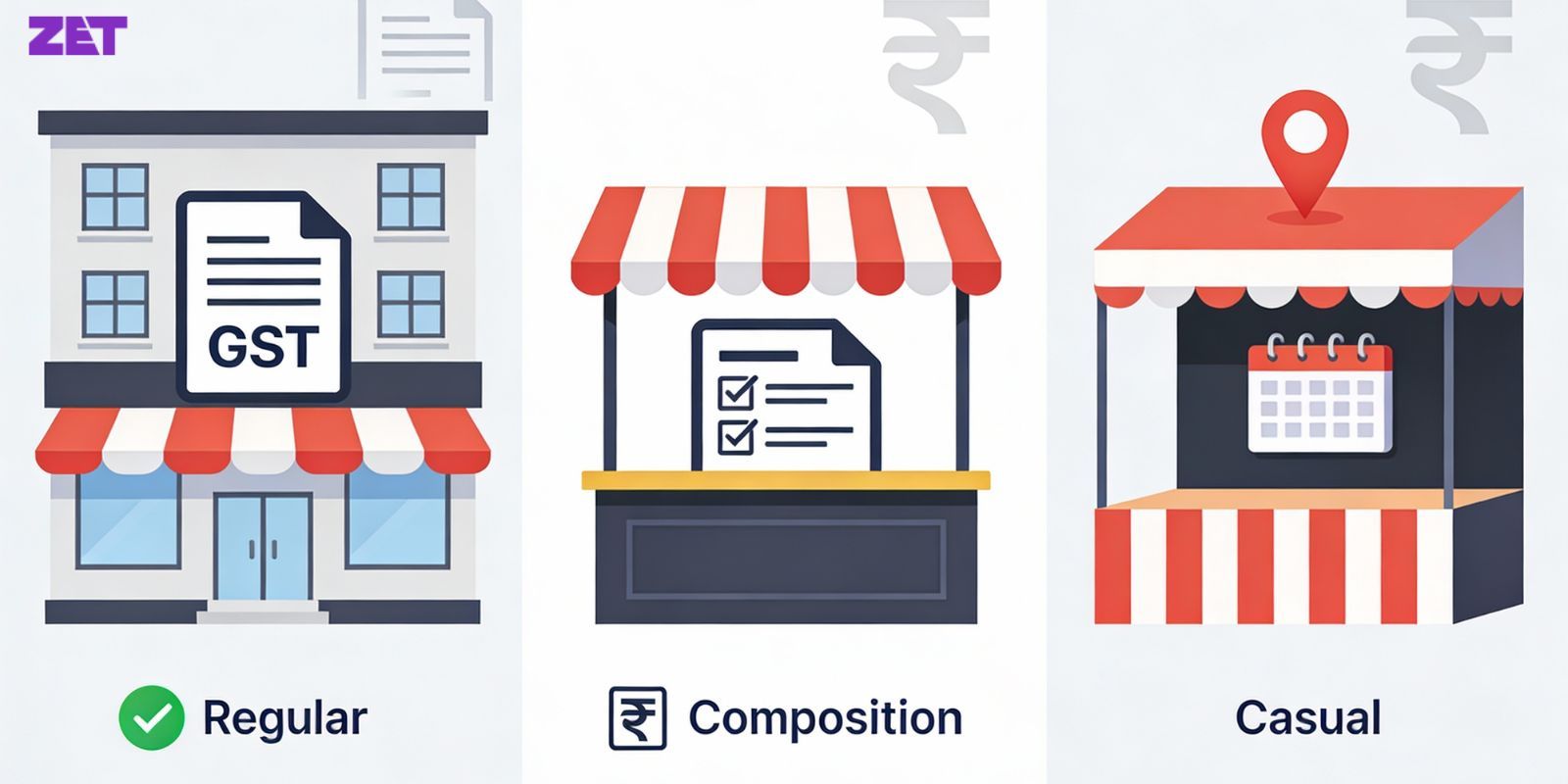
To suit those different needs, the law offers multiple GST registration options. Broadly, the three primary types of GST registration in India are:
1: Regular GST Registration
2: Composition Scheme GST Registration
3: Casual Taxable Person GST Registration
There are others—like NRI business, TDS/TCS deductor, ISD—but almost all SMBs are in one of the three above. This guide delves deeply into these fundamental types, making sure you get a handle on when and why each is employed.
Also Read: What is UPI 2.0?
If GST registration types were mobile phone plans, Regular Registration would be the all-you-can-eat plan with every feature unlocked. It’s the most agile, most potent, most popular class.
This category is meant for:
1: Businesses with annual turnover above the threshold (₹40 lakh for goods, ₹20 lakh for services; may vary by state).
2: E-commerce sellers on Amazon, Flipkart, Meesho, and more—irrespective of turnover.
3: Businesses that want to claim full Input Tax Credit (ITC).
4: Service providers, manufacturers, and wholesalers with B2B buyers.
5: Any business that favors complete compliance and sustainable scalability.
Also Read: How To Invest in Post Office FD?
A regular GST business can charge GST, collect it, and avail ITC on taxes paid on purchase. This input credit claiming capability really slashes costs and drives pricing competitively, particularly in B2B arenas where clients require GST invoices.
For instance, if you operate a small IT consultancy and purchase software licences that already have GST applied, your cost burden decreases as you can claim that tax as a credit. Similarly, a manufacturer purchasing raw materials thrives under this system.
A Regular GST taxpayer must:
1: File monthly or quarterly returns depending on turnover.
2: Keep good purchase and sales notes.
3: Generate accurate tax invoices with HSN or SAC codes.
4: Reconcile data timely on the GST portal.
This category requires discipline, but in exchange, you earn legitimacy, input credits, and enduring business stability.
Also Read: Can We Invest Monthly In FD?
If the Regular Registration is a full-feature plan, the Composition Scheme is the simplified, low-maintenance plan for small traders and service providers. A lot of micro-business owners—local kirana shops, small restaurants, tailoring units, or stationery stores—like this because it eliminates paperwork significantly.
This plan is intended for companies with
1: Annual turnover up to ₹1.5 crore (₹75 lakh for some states).
2: Localised, predominantly B2C customers.
3: Little requirement for input tax credit.
Service providers were originally barred, but are now permitted under a special composition class up to ₹50 lakh turnover.
Also Read: How to raise your credit score by 200 points
Under the Composition Scheme:
1: You pay tax at a fixed, lower rate (1% for traders, 5% for restaurants, 6% for service providers).
2: You cannot issue GST invoices; only a "bill of supply".
3: You cannot claim input tax credit.
4: You must file quarterly returns, making compliance far easier.
5: You cannot sell outside your state if you are a goods supplier.
Businesses that operate mainly in cash, serve local customers, and purchase low-input-tax goods don't require ITC. Their customers seldom require tax invoices; therefore, the Composition Scheme eases tax anxiety, paperwork, and risk of penalties.
A local bakery with pastries and snacks, for instance, may not require invoices. It is also advantageous in that it pays a flat tax on total turnover rather than having to calculate the GST monthly.
Also Read: How to Increase CIBIL Score from 650 to 750
Businesses should not opt for this scheme if:
1: They deal with B2B clients.
2: They rely significantly on the input tax credit.
3: They intend to sell online or cross-state.
4: They anticipate a swift expansion in turnover beyond ₹1.5 crore.
In these instances, Composition can limit growth.
This is the least understood type, but very important for businesses that participate in temporary, seasonal, or location-specific events.
Say, for example, you have a handicraft brand in Mumbai, but you set up a stall at a Diwali exhibition in Delhi for 10 days. You're not a long-term business in Delhi, but you still have to pay GST there. This is exactly where the Casual Taxable Person (CTP) registration applies.
Also Read: What is UPI Collect?
This type is used by companies that.
1: Operate seasonally at fairs, exhibitions, pop-up markets, festive stalls, or trade expos.
2: Have no place of business in the state where they are transitorily selling.
3: Sell taxable items for a limited time.
1: It is valid for a maximum of 90 days, extendable once.
2: The business must pay an advance GST deposit equal to the expected tax liability.
3: Regular returns still must be filed during the active period.
4: You can also raise tax invoices and claim input credit on inputs bought for the event.
5: It is only valid for that time and place.
Also Read: Is BHIM UPI and Google Pay the Same
Since the taxpayer is not an established business in that state, the system protects revenue by taking estimated tax upfront. And after the last return is filed, any extra will be refunded.
Brands that attend seasonal festivals, art fairs, jewellery shows, or wedding expos often sign up for short-term CTP registrations. It keeps them within the law and lets them send out bona fide bills and preserve legitimacy.
Picking your registration is a tactical choice. A local beauty parlour might love Composition, but a boutique that ships on Instagram across states has to take Regular Registration. Likewise, a designer who visits 3 exhibitions a year in different cities will need Casual Registration at each location.
You should evaluate considerations like
1: Your customer type (B2B or B2C)
2: Your expected annual turnover
3: Whether you need an input tax credit
4: Whether you plan to sell online or in multiple states
5: Whether your business is seasonal, one-off, or long-term
There’s no one-size-fits-all “best” type – only the best type for your business model.
Also Read: Are UPI PIN and MPIN the Same
A lot of small business owners are intimidated by compliance. But once you match your business requirements to the appropriate registration category, GST is really simple to deal with.
For example:
1: A stationery shop with local customers and predictable turnover benefits from Composition.
2: A graphic designer working as a freelancer for clients across the country enjoys Regular Registration.
3: A wedding photography team at a two-week destination event in another state [uses CR].
Without clarity on the types of GST registration, choosing blindly can increase tax cost, block input credits, or result in penalties.
GST registration isn’t just a legal formality—it defines how your whole business operates financially. Getting the right types of registration under GST ensures you pay the right tax, maintain credibility, and avoid compliance headaches.
Whether you choose Regular, Composition, or Casual, ensure it aligns with your growth goals. When in doubt, check in with a financial advisor or GST practitioner so you never pay more tax than you should or restrict your business by accident.
Also Read: Best Credit Cards for Shopping at Amazon & Flipkart
Hosting three categories – Regular GST Registration, Composition Scheme Registration, and Casual Taxable Person Registration. Each type is suitable for different businesses depending on turnover, customers, and frequency/location of the trading.
Select Composition if your turnover is less, customers are local, and you don't require input tax credit. Select Regular registration if you serve B2B clients, sell online, operate in more than one state, or require ITC for business expenses.
Yes, a business can shift from Composition to Regular or vice versa, but only at the beginning of a financial year. Switch to Regular can happen sooner if turnover exceeds the threshold.
Yes, if you sell taxable articles or services at a fair or event in a state where you don’t have a permanent business location, you require a Casual Taxable Person registration for that period.
Yes, all sellers on e-commerce platforms need to use Regular GST Registration even if their turnover is below the threshold.



Contact

care@zetapp.in
Social


Build and Maintain a 750+ Credit Score