February 25, 2026 · 7 mins read
Santosh Kumar
GST return filing and payment necessitates registered taxpayers to file returns and pay taxes within stipulated timelines. Late or non-compliance may constitute late fees, interest and penalties, further increasing the strain on companies and individuals. GST late fees and penalties – what you need to know

GST late fees are for late return filing and interest is for late payment. Penalties for non-compliance, incorrect reporting, or tax evasion. GST compliance rules are framed and regulated by the likes of the Goods and Services Tax Council, which updates provisions and compliance requirements from time to time.
GST late fees apply to when a taxpayer files GST returns beyond the due date. These charges are for returns like GSTR-1, GSTR-3B, and annual. The late fee accrues daily until the return is filed, up to a statutory maximum.
Late fees apply even if there is no tax due for the return. The purpose of late fees is to incentivize timely filing of returns and keep transaction reporting under GST accurate.
The late fee is usually charged separately under CGST and SGST. It can be different depending on if its a tax return or a nil return. Nil returns usually draw smaller late fees than returns with a tax bill.
Also Read: How to Apply for a ₹2,000 FD Credit Card on ZET App: A Step-by-Step Guide?
Other than late fees, interest is levied where taxpayers do not pay GST liability by the due date. Interest is charged on the unpaid tax amount for the duration of the delay and is distinct from the late filing fee.
The benchmark fine rate for late GST remittance is often 18% pa. Interest runs from the day following the due date until taxes are satisfied. Because interest is a function of the unpaid tax and delay, the amount you end up having to pay goes up with time.
That’s different from late fees, which are flat per day, and interest, which fluctuates with the unpaid tax amount. So while you’re at it, it’s important to get your GST liability paid on time, too, in order to circumvent the extra strain on your wallet.
Also Read: ₹2,000 FD Credit Card Limit: How Much Limit Can You Get?
GST penalties are levied for violations like non-registration under GST when liable, tax evasion, issuing incorrect invoices, ineligible input tax credit claims, or furnishing false particulars in returns. The fine varies according to the type and seriousness of the violation.
For small or inadvertent errors, the penalty might be diminished or forgiven if taxpayers come forward and fix the mistake and pay the tax. But intentional tax evasion or fraud can incur heavy penalties, frequently based on a proportion of the tax at issue.
GST penalties exist to ensure tax compliance and to deter fraudulent activities.
Also Read: How to Get a Credit Card with Just a ₹2,000 FD in India
You can incur GST late fees and penalties in a few scenarios. These involve late filing of GST returns, late payment of tax dues, non-registration under GST where liable, and erroneous reporting of transactions.
Penalties can also catch out a taxpayer who issues wrong tax invoices, maintains improper records, or claims excess input tax credit. And repeated non-compliance can lead to more intense attention from tax authorities and increased penalties.
By knowing these situations, businesses can stay compliant and steer clear of avoidable fees.
Also Read: How to solve ‘UPI ID Not Found’ error?
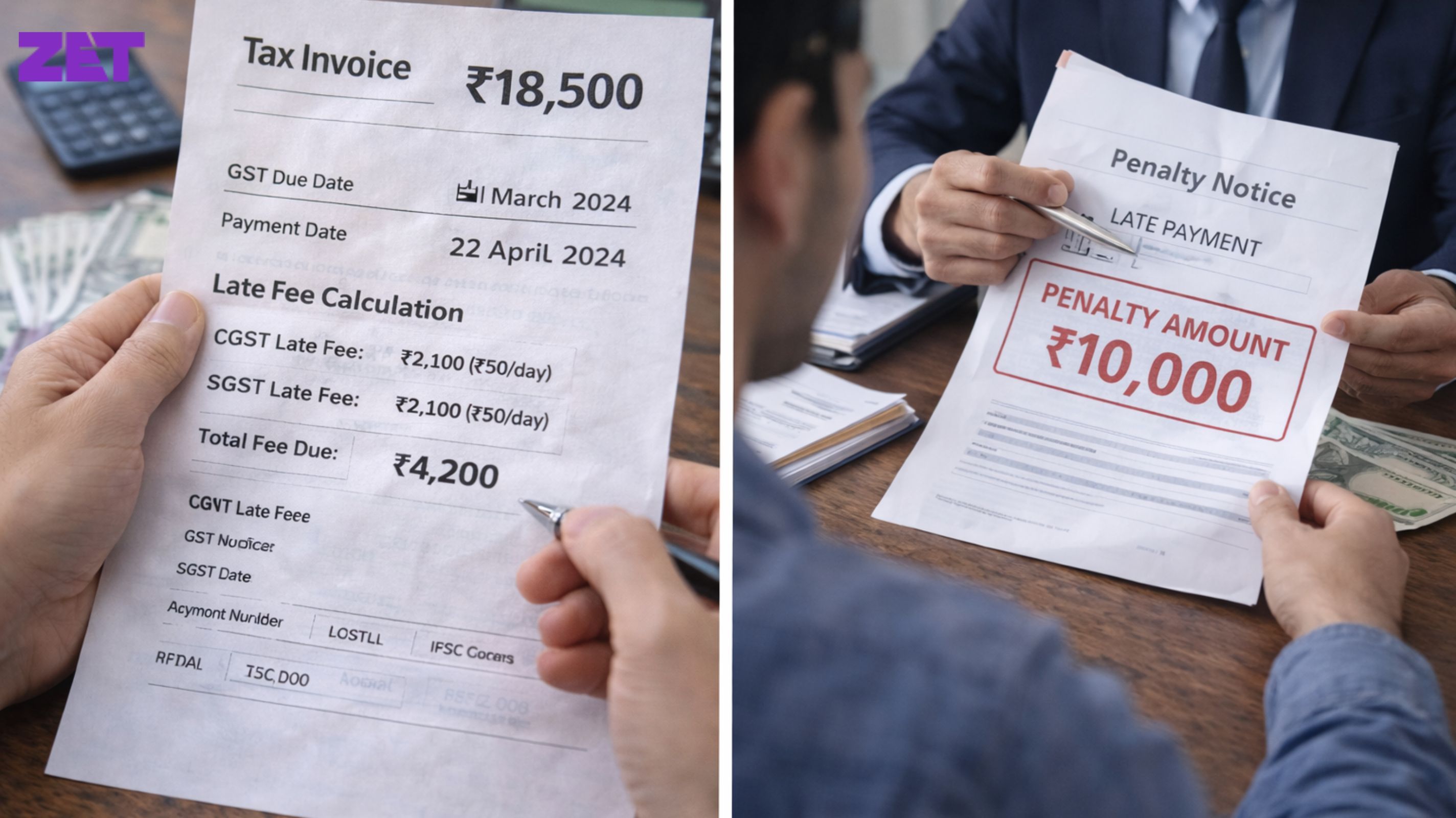
GST late fees are charged daily until the return is submitted. The value varies based on the nature of the return and if the return includes tax obligation. It also sets caps on late fees.
For instance, if the late fee is ₹50 per day, for late filing a return having tax liability, the fee will continue to accumulate daily till the return is filed – up to the maximum limit prescribed. For nil returns, the late fee tend to be less.
Let’s say a company submits its GSTR-3B return 12 days beyond the deadline. If the late fee is ₹50 per day, then the late fee would amount to:
Late fee = ₹50 ×12 days = ₹600 If the same return is a nil return with a ₹20 per day late fee, total late fee would be:
Late fee = ₹20 × 12 days = ₹240! In this example, the late fee increases with the number of days of delay.
Also Read: What Is UPI 123Pay and How to Use It Without Internet?
And interest is calculated on the outstanding tax according to days of delay. The GST interest formula is as follows:
Interest = Tax Amount × Interest Rate × Days late ÷ 365
Now suppose a taxpayer has a GST liability of ₹2,00,000 and pays after a delay of 25 days. At 18 percent per annum, the interest would be
Interest = ₹2,00,000 x 18% x 25 / 365 Interest = approximately ₹2,466
This has to be paid on top of the tax and any late fees.
Also Read: GST For Home-Based Businesses: Do You Need It?
Government mandates caps on GST late fees by return type and tax liability. After the cap is reached, no additional late fee is imposed even if the delay continues.
The government can change late fee limits or offer relief during special cases. Taxpayers should stay informed with the recent notices.
Failure to comply with GST laws can lead to penalties, interest charges and legal action. Non-compliance may also affect business reputation and create additional scrutiny from the taxing authority.
Late GST returns or payments may disrupt your business schedule and cash flow. When you remain in compliance, you can avoid these complications and keep your business operating smoothly.
The purpose of GST penalties and late fees is to promote behaviour that will comply with the various provisions of the G.S.T. Act. There are penalties – for late filing, late payment, non-compliance and/or fraud – for every late event. To avoid incurring additional costs from penalties associated with late filing or payment of G.S.T. taxes, it is necessary that businesses maintain accurate records of their financial transactions, file their returns by the due date and pay their G.S.T. taxes when due. In order to be financially viable and achieve continued compliance, it is essential that businesses understand the rules of the G.S.T. and maintain a high level of financial discipline.
Late fees for GST returns must be paid on a daily basis when a return is filed late, with fixed limits authorized. The charge may vary based on the return type and the total amount of GST collected.
Nil GST returns will also be charged late fees; however, generally, the fee charged for filing a nil return will be less than the fee charged for a return that has tax liability.
Interest for late payment of GST is generally charged at the annual rate of 18% on the amount due.
The taxpayer may voluntarily correct errors and comply with GST provisions to apply for the waiving or reduction of late payment penalties.
The best way for a business to avoid late fees or penalties under GST is to file their returns on time, keep good records of all of their purchases/sales, make timely payments of their taxes, and comply with GST regulations.
If GST is not paid on time, the business may be charged interest on a late payment, incur late fees, pay penalties, and be subject to legal action for their non-compliance, depending on the nature of the non-compliance.



Contact

care@zetapp.in
Social


Build and Maintain a 750+ Credit Score