December 17, 2025 · 10 mins read
Santosh Kumar
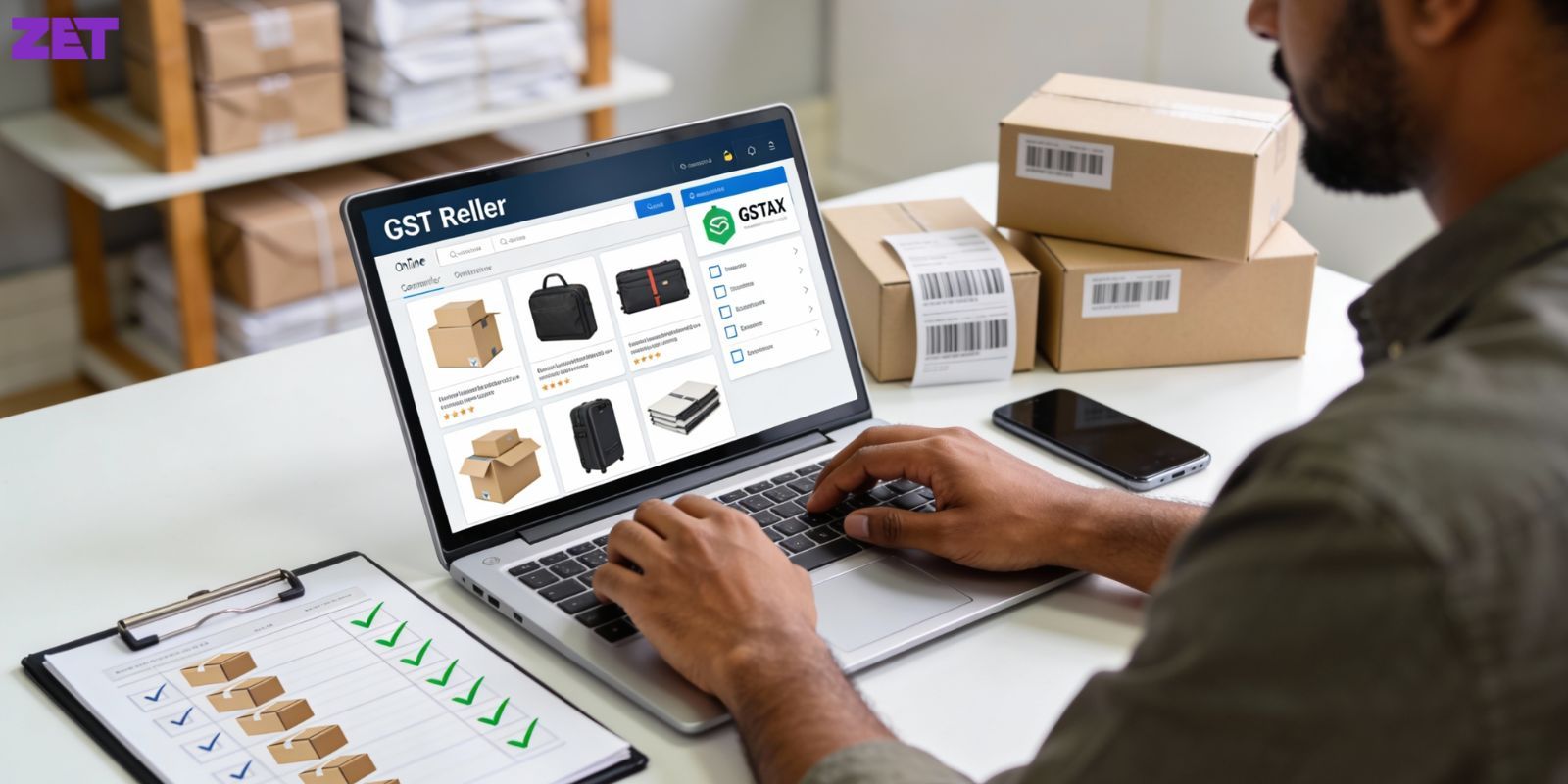
The Indian e-commerce sector has been completely revolutionised in the past 10 years. eTailing is not an urban indulgence but a national shopping habit cultivated by consumers everywhere. This has meant that small and medium-sized sellers, who used to rely solely on physical stores, now utilise platforms like Amazon, Flipkart, Meesho, JioMart, Myntra, and even independent Shopify stores to access a much broader audience.

But, as much as the digital universe is expansive, it opens up a whole new regulatory realm. GST is one of the most important things about selling online. Knowing GST requirements is intimidating, particularly for rookie sellers grappling with invoices, returns, monthly filings & registration rules. But once you get a grasp on how GST works for online sellers, compliance is doable and keeps your business running smoothly and professionally.
GST is a destination-based indirect tax on the supply of goods and services in India. Under this single tax system, goods or service providers must adhere to registration, invoicing, and return filing requirements.
For conventional brick-and-mortar sellers, GST registration is necessary only when their turnover exceeds ₹40 lakh (₹20 lakh in some cases). But it’s a totally different story for online sellers. If you sell via an e-commerce marketplace, GST registration is required from day one, regardless of turnover.
This is among the key differences new sellers need to grasp. Even if your online business is small—just a few orders a month, you have to register for GST prior to onboarding with any major marketplace. Platforms need a GSTIN of the seller to activate them on the platform, as they are liable to collect and report tax transactions on your behalf.
Also Read: Annual Fee vs Lifetime Free Cards
The main motivation for this rule is tax collection at source (TCS). E-commerce platforms collect TCS on each sale you make and remit it to the government. For this to work seamlessly, the seller needs to have an active GSTIN for the system to be able to match the transactions.
This allows all online commerce to be accountable, open and tax compliant. It also avoids revenue leakages and allows appropriate credit to flow back to the seller. Therefore, even if your sales volumes are low, you must complete gst registration for e commerce seller before listing your products online.
Also Read: Credit Card Cash Advance
And of course, any merchant that is using an e-commerce platform to provide goods or services would require GST registration. This includes:
1: Sellers supplying physical products such as apparel, accessories, electronics, home décor, and groceries
2: Artisans and handicraft creators selling through curated marketplaces
3: Service providers offering home services, consulting, or digital services through e-commerce platforms
4: Dropshipping businesses and print-on-demand store owners
5: Sellers running their independent online stores using Shopify, WooCommerce, or custom websites
6: Resellers using platforms like Meesho or GlowRoad
GST registration is mandatory even if your turnover is very low, as long as your supplies are through an e-commerce operator.
Also Read: Credit Card Renewal & Replacement
Though GST registration might appear as an extra burden, it brings in significant benefits, actually. Buyers trust sellers with GST information, and most platforms promote registered sellers. Registration also enables you to avail input tax credit (ITC) on packaging, raw materials, logistics charges, warehousing fees and other business expenditure.
Plus, GST compliance guarantees smooth cash flow — online marketplaces can reconcile your returns and tax deposits for you automatically. And for sellers who are planning to scale or scale to multiple states, a GSTIN is a must. It makes it easier to do business across state lines and provides a standardised national tax experience.
Put simply, registration isn’t just a legal necessity–it’s a business enabler that gives your e-commerce brand professionalism and credibility.
Also Read: Types of GST Registration in India
Prior to starting the online application, have all your documentation in order. The GST registration documents for an e-commerce seller include:
1: PAN card of the business or proprietor
2: Aadhaar card of the applicant
3: Proof of business address, such as an electricity bill, a rent agreement, or a property tax receipt
4: Bank account details, including a cancelled cheque or bank statement
5: Passport-sized photograph
6: Business constitution documents, such as a partnership deed or an incorporation certificate, if applicable
7: Digital signature (DSC) for companies and LLPs
Every paper should be lucid, properly scanned, and current. Wrong papers or mismatched information can cause a verification delay. As online marketplaces ask you to provide GST information at onboarding, it’s preferable to complete registration early.
Also Read: What is UPI 2.0?
GST registration is completely online and can be done on the GST portal. After clicking ‘New Registration’ and confirming your mobile number and email, you need to complete business information like legal name, trade name, main address, business type and bank details. Here, you’ll upload the required documents of proof of identity and business address. Upon application, you will get an ARN to track the progress. GST authorities might seek clarifications, and after approval, your GSTIN is issued.
GSTIN should be mentioned on your online marketplace seller profile, invoices, and product packaging (wherever applicable) and business communication. Only after you provide your GSTIN will most e-commerce platforms turn on your account.
One of the fundamental obligations under GST is generating proper tax invoices. If you sell products online, the invoice has to have
1: The seller’s name, address, and GSTIN
2: The buyer’s details
3: A serial invoice number
4: Invoice date
5: Description and quantity of goods
6: HSN code for each product
7: Taxable value of the goods
8: GST rate and tax amount
9: Total value including taxes
10: Place of supply
E-commerce platforms typically invoice automatically through their systems, which comply with the GST rules. But having your own copies and knowing the format allows you to check for correctness and avert conflict.
Also Read: How To Invest in Post Office FD?
TCS is among the most unique aspects of GST compliance for online sellers. If you sell goods through an e-commerce operator, however, then the platform avails itself of this facility — it deducts a tiny percentage of the sale value and deposits it with the government. This is called TCS (Tax Collection at Source).
Currently, TCS is collected at a low rate, and the sum shows up in your GST portal as a credit. And sellers can take this credit as they file returns, so the amount is not lost but instead adjusted against your tax liability.
Why you should care about TCS: it’s what determines your settlement amount and your financial reconciliation. Sellers should periodically review these credits for correctness.
GST return filing is routine compliance and must be done timely to avoid penalties. Sellers will usually have to submit outward supply information and monthly summary returns.
E-commerce platforms file TCS returns separately, and these entries automatically reflect in your portal. You need to try to make your own returns reconcile with the platform’s. Any mismatch will cause notifications and a credit delay.
While filing returns sounds like a chore initially, if you actually keep accurate records of sales, purchase invoices, returns, shipping expenses, etc., it’s very doable. Most vendors employ accountants or automated software to sidestep compliance blunders.
Also Read: Can We Invest Monthly In FD?
That’s the benefit of online selling – having access to customers all over India. But this also introduces extra compliance considerations. If you stock inventory in multiple states, ie Amazon FBA warehouses, you will need multiple GST registrations for each state where your inventory is stocked.
This varies based on your marketplace’s structure and your storage model. Be sure to also check warehouse location rules to find out if you need to register in more than one location. The GST portal also enables businesses to file for more places of business under one GSTIN, based on the supply type.
E-commerce is rife with returns and cancellations. For product returns or order cancellations, we need to adjust for the GST portion charged on the original sale. via credit notes, crediting them with their reduced tax liability.
E-commerce platforms such as Flipkart and Amazon automatically generate credit notes on returned orders, but sellers will need to ensure these entries are correctly reflected in their GST returns. Reconciliation, on the other hand, prevents penalties and keeps your numbers straight.
To keep compliant year-round, e-commerce businesses should engage in the following process. This involves correct registration, issuance of invoices, review of TCS credits, timely return filing, reconciliation of monthly statements from marketplaces, books of accounts, etc.
This forward-thinking approach minimises your error exposure and ensures your business stays audit-ready. Though compliance may sound time-consuming, incorporating software tools and organised record-keeping will simplify the entire process.
Too many new sellers make easy-to-avoid violations that result in penalties. Standard problems are using the wrong HSN code, overlooking TCS credits, deadlines for filing returns, not reconciling marketplace reports, or using antiquated business details on invoices. These errors can be rectified early by knowing the GST regime well and consulting an expert when required.
E-commerce firms that have consistent GST compliance reap benefits down the road. Marketplaces want to feature and support sellers who follow the rules. Banks like doing business with companies that have a clean GST history — which means it’s easier to get favourable credit as well.
In addition, a compliant seller establishes trust with customers, partners and investors. Smart tax planning is the foundation of a healthy online business that scales sustainably.
Yes. Any dealer providing goods or services through an e-commerce platform has to register for GST, irrespective of turnover. Even a starter with low monthly sales needs a GSTIN prior to enabling their seller account.
Yes. E-commerce sellers must lodge normal returns — GSTR-1 and GSTR-3B — and marketplaces file distinct TCS returns that should correspond with your filings.
Absolutely. All leading platforms ask for GSTIN details prior to listing products or accepting payments. Without signing up, your seller account can’t be enabled.
No, not if they sell via an e-commerce operator. Turnover ceilings are not applicable to online sellers. But offline-only sellers might have threshold-based rules.



Contact

care@zetapp.in
Social


Build and Maintain a 750+ Credit Score