December 11, 2025 · 9 mins read
Santosh Kumar
Credit cards are convenient and flexible, and more important than ever in our daily spending. From e-commerce to reservations, they provide convenience, security and incentives. Yet, there is one feature that every cardholder must treat with extreme caution: the credit card cash advance.

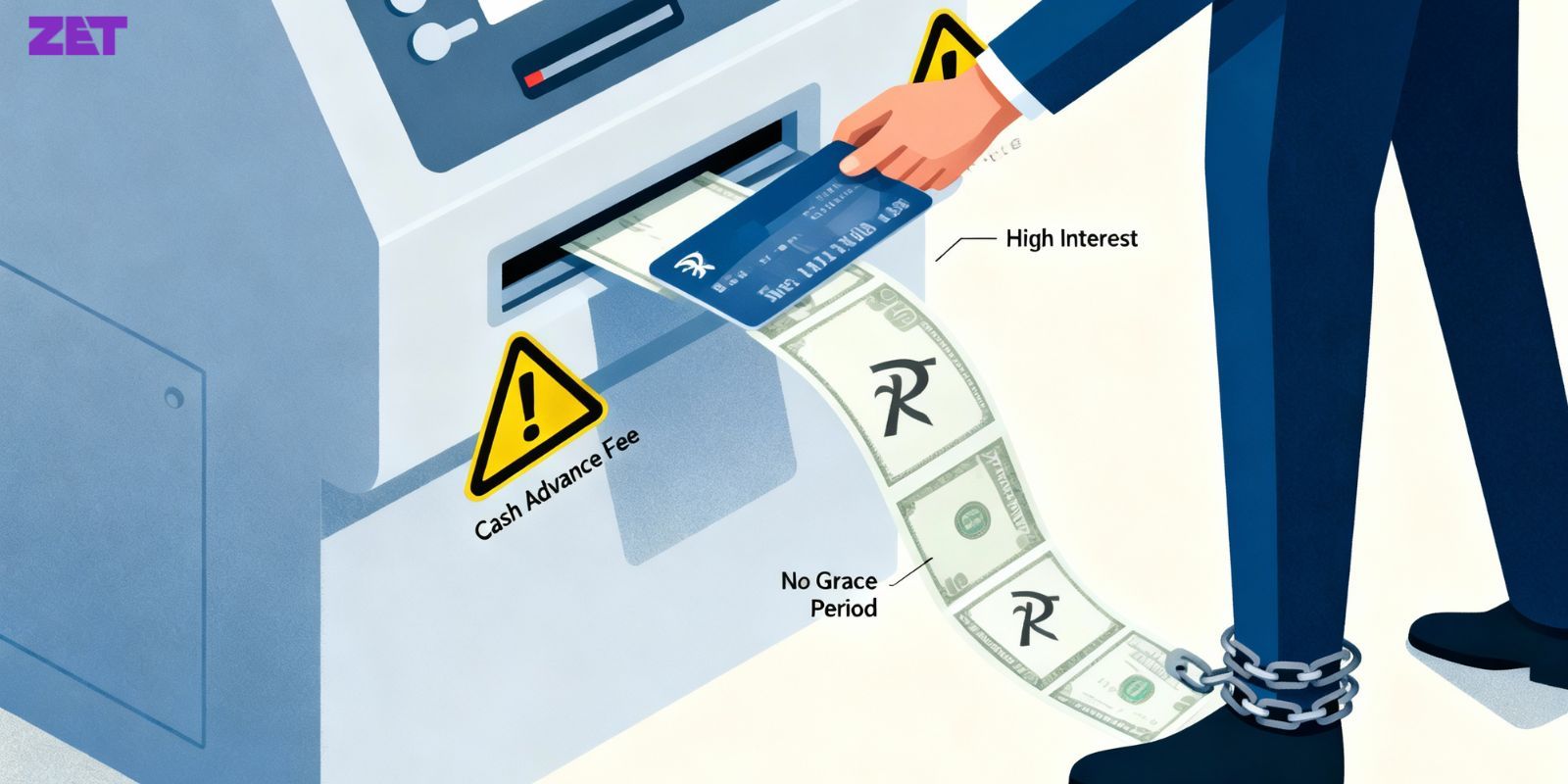
On the surface, taking out cash via your credit card seems innocent. You visit an ATM, withdraw money, and cope with it afterwards. Simple. But lurking behind this convenience are numerous monetary pitfalls — steep interest, additional charges, and absolutely no interest-free grace periods — that can rapidly transform a minor withdrawal into a major obligation.
This article breaks down why you should avoid credit card cash advances, what charges you face, how they work, and what safer alternatives you can consider instead.
A credit card cash advance allows you to withdraw physical cash using your credit card instead of a debit card. You are able to do it with most ATM’s, bank branches or even cash equivalents (some e-wallet loading, gaming token or sending cash).
Put simply, it’s the credit card equivalent of a payday loan.
With loans, you know what you’re getting into — interest rates, processing fees, repayment plans. With cash advances, you usually don’t know how steep it is until the statement comes. A cash advance is one of the costliest features of a credit card, and understanding this is essential before you ever consider using it.
Also Read: Can I Invest in an FD in My Wife’s Name?
The moment you withdraw money using your credit card, the bank charges what’s called the credit card cash advance fee. This is a fixed fee or a percentage of the amount withdrawn – whichever is greater, depending on the bank.
For example:
If your bank charges a 2.5% cash advance fee, and you withdraw ₹10,000, you instantly pay: ₹10,000 × 2.5% = ₹250 (plus GST)
This fee shows up on your next statement, even if you pay it off right away.
Also Read: How to Withdraw Money From Phonepe Wallet
Almost all non-credit card purchases include an interest-free grace period, too — typically 45–50 days — if you pay your bill on time.
A cash advance does NOT get this benefit.
Interest starts accumulating from the very moment you withdraw cash, not from the statement date. That’s how cash advances can get so freaking expensive in just a few weeks!
If your card has an interest rate of 36% per annum, it could mean:
1: Around 3% per month,
2: Charged daily,
3: Until you repay the full amount.
Even if you pay off some of the bill, the remainder still accumulates interest.
Also Read: Virtual RuPay Cards: Using UPI without Bank Account
Credit card issuers want to deter frivolous borrowing. Therefore:
1: No reward points
2: No cashback
3: No milestone benefits
4: No promotions or offers
Cash advances earn nothing — except interest and fees.
When you pay with your card the normal way, at least you receive rewards. With cash advances, you pay more and get nothing.
Also Read: How to Transfer Money From Phonepe Wallet to Bank Account
Let’s examine why, and in practical, real-world terms.
With interest beginning immediately and compounding daily, even minor withdrawals balloon. A lot of people pay late or partially, all of which piles onto the next month's strain.
If you abuse cash advances, you can wind up in a debt spiral that’s hard to break free from.
Even one cash advance screws up your financial discipline. Suddenly:
1: Your statement amount becomes much higher.
2: Interest gets added daily.
3: You sacrifice the luxury of interest-free windows.
4: Your next cycle feels shorter and more expensive.
A lot of customers call it “the one thing that disrupts your cash flow”.
Also Read: Top Credit Cards for International Travel in 2025
Beyond cash advance fees and interest, certain banks impose:
1: ATM usage fees
2: Network fees (Mastercard/Visa)
3: Additional GST
4: Over-limit charges (if applicable)
So what looked like an easy ₹5,000 payout might end up costing ₹5,800 or more.
One cash advance won’t directly wreck your credit score. However:
1: It indicates high dependency on credit.
2: If you miss payments afterwards, your score drops.
3: A high utilisation ratio can affect credit health.
It’s a bankruptcy sign in the eyes of lenders.
Credit cards often come with a couple of limits:
1: Total credit limit
2: Cash limit (usually 10–20% of total)
Withdrawing without verifying your limit may result in
1: Over-limit penalties
2: Transaction failure
3: Blocking of the card in extreme cases
Also Read: Which Credit Card Offers Fuel Cashback in India?
To be clear, credit card cash advances are not “bad” — they’re pricey. They are there for emergencies, like:
1: Immediate medical emergencies
2: A lost debit card while travelling
3: Cash-only locations in remote areas where digital payments fail
If you genuinely have no other option, using a cash advance is acceptable. But use it as a temporary crisis bridge, not a habitual loan.
Before you even pull cash from your credit card, think about these less risky, less expensive alternatives.
Most banks also support conveniently converting large spends into EMIs right off your credit card! This comes with:
1: Lower interest
2: No cash withdrawal
3: No extra penalties
4: Instant approval
Perfect for when you need money, but not necessarily money in cash.
Also Read: What is Virtual Credit Cards & Physical Cards
Today’s personal loans are fast, completely online and far more affordable than cash advances. A lot of lenders do small loans in minutes.
Rates are much smaller — sometimes 12%–18% instead of 36%+.
Banks will occasionally loan against your credit card limit, with
1: Lower interest
2: No cash advance fee
3: Flexible EMIs
That’s still less costly than a cash withdrawal.
savings account overdraft (OD) interest on a used amount basis only.
1: Lower interest
2: No penalty for early repayment
If you’re strapped, but not for cash, a credit limit increase can help.
For micro-transactions, BNPLs provide free instalments and lower fees.
If it doesn’t cost cash, BNPL is always smarter than taking it out of your credit card.
To keep from ever requiring a cash advance, try building.
1: An emergency fund
2: A small overdraft facility
3: Good credit card habits
4: Monthly budgeting
5: Appropriate digital payment tools
6: A backup debit card or UPI wallet
Planning in advance saves you from having to float at usurious interest.
A credit card cash advance sounds like a useful shortcut, but it has among the highest fees and interest rates in personal finance. From the instant credit card cash advance fee to daily compounding interest and the lack of interest-free periods, the costs add up quickly. In truly desperate times, a cash advance can be a godsend. But barring emergencies, it should be off limits entirely. There are safer, cheaper and smarter alternatives — personal loans, card EMIs, overdrafts and digital credit options — that maintain your financial health without ensnaring you in predatory interest debt.
Financial security derives from transparency and savvy choices. Opting to reject cash advances is among the toughest moves towards lasting financial security.
A credit card cash advance fee is what you pay every time you take out cash with your credit card. It’s typically 2.5%–3% of the amount taken out or a set minimum fee. This is billed immediately and will show on your next statement.
Cash advances have no interest-free period. Interest begins from the day you take money out and runs until you pay it all back. This is what makes it so much costly than normal card purchases.
Withdrawing cash doesn’t directly hurt your credit score. But if the steep interest makes you miss payments or maintain large balances, your credit score will plummet.
Don’t take out cash advances on your credit card. Instead, think about personal loans, card-based EMIs, overdraft, or bank credit card loans. These options are way cheaper.
Only in rare emergencies. If the digital payments go down, you’re on a trip or in a medical emergency, and you desperately need some cash, hey, a cash advance is fine. But pay it off as fast as you can.
You can pay off right away, but interest still accrues from withdrawal until repayment. And unlike purchases, there’s no grace period.
The safest options are converting purchases into EMIs, taking a short-term personal loan, using BNPL options, or asking for a loan against your credit card. All of these have much lower fees.



Contact

care@zetapp.in
Social


Build and Maintain a 750+ Credit Score