December 11, 2025 · 9 mins read
Santosh Kumar
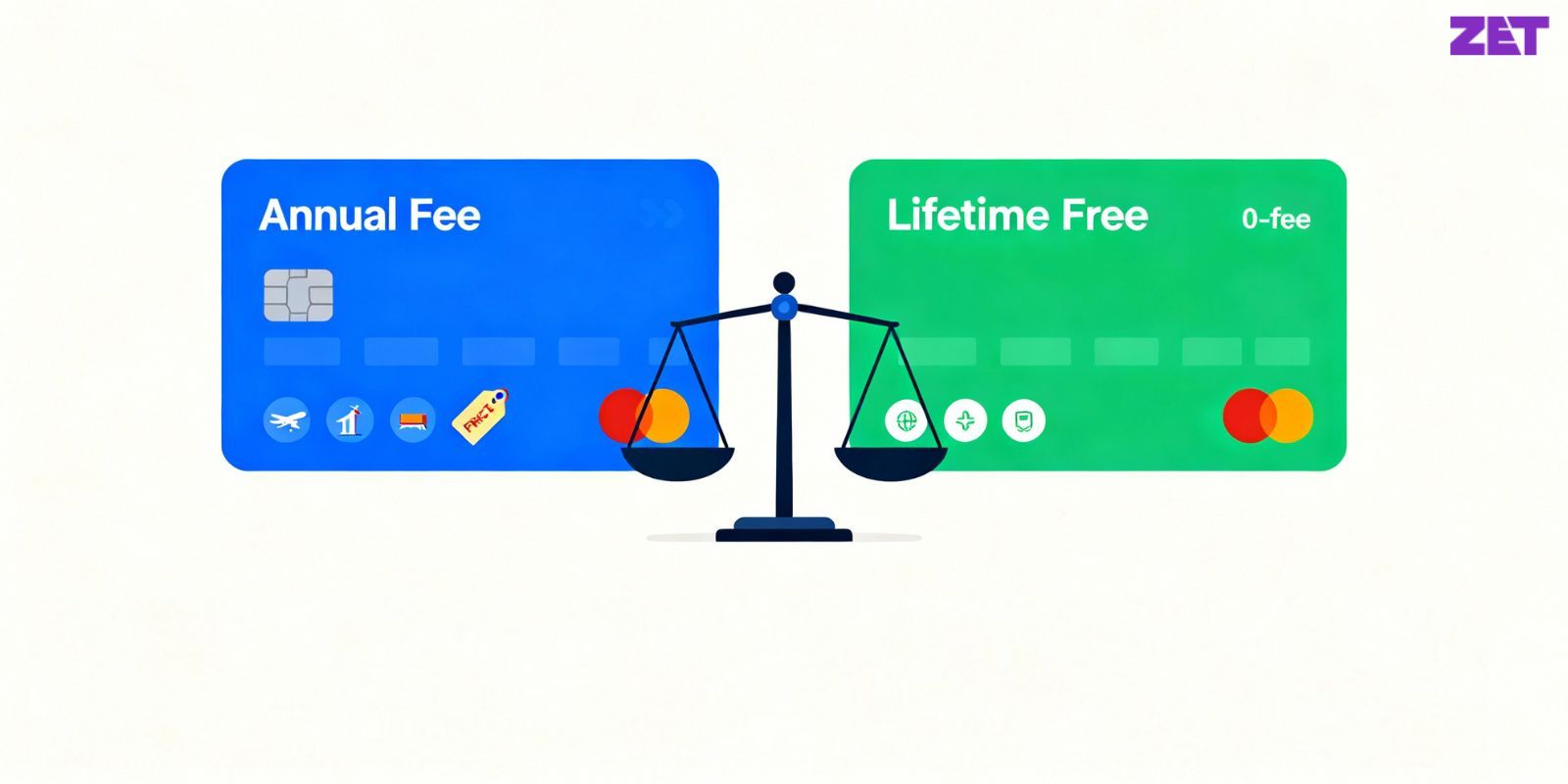
Credit cards have evolved beyond a mere convenient payment mechanism — they are now an indelible part of our financial persona. Whether it’s racking up reward points, snagging travel deals, gaining access to airport lounges, or just establishing a solid credit history, the right credit card can discreetly power your lifestyle and long-term goals. But picking the right card isn’t always easy, particularly when banks provide multiple variants with varying fee structures. Among the most frequent conundrums we all face is this: Should you go for a card with an annual fee or get a lifetime free credit card?

It’s a dilemma with no one-size-fits-all solution. Which one is right for you also comes down to how you spend, your lifestyle and your money management and what you really value in a card. But before spending some time with my suggestions, it’s critical to first become acquainted with the distinction between these card varieties and what each provides. That makes your choice more obvious and much more feasible.
To start with the basics, you must know what a lifetime free credit card is. In plain English, it’s a card that never charges an upfront fee when you sign up, and no annual fee for any subsequent year. It’s free to keep forever, even if you use it a lot or hardly at all. These bad boys are a nice deal for first-time credit users — students, young professionals and anyone looking to start establishing a credit score without worrying about ongoing fees.
While lifetime free cards are not necessarily premium in terms of benefits compared to fee-based cards, they offer the liberty of retaining a credit line at nil cost. This is incredibly helpful for establishing a long credit history, maintaining low credit utilisation through an additional line of credit, or just having a card stashed away for a rainy day. To a lot of people, the ease and low cost are what make lifetime free cards appealing as a launch pad.
Also Read: What is UPI 2.0?
As opposed to lifetime free cards, annual fee cards bill you a fixed amount each year for having the card. This fee can range from tiny annual fees for ‘no frills’ cards, up to thousands of rupees for luxury and super-premium cards targeting frequent travellers, big spenders or reward maximisers.
To know if a card is really worth its fee, you need to account for the value of its benefits. For instance, if a ₹1,000 annual fee card gives you ₹3,000 of vouchers annually, airport lounge access and bonus points, it could provide more net value than a free card that provides none of these.
The first step in assessing a card is learning how to check the credit card's annual fee. Which is always explicitly detailed in the credit card’s pricing document on the bank’s website, in the MITC file, or in the pre-approval fee schedule. You can also see it in your monthly card statements or by calling customer service. Knowing the fee allows you to determine if the card actually fits your habits and offers enough value to be worth it.
Also Read: How To Invest in Post Office FD?
While everyone’s financial road may be different, lifetime free credit cards generally come out on top in specific cases. Say, for instance, that you’re inexperienced with credit but just want to get a start on a credit footprint — a free card makes a great base without the burden of what amounts to annual fees. A lot of banks these days provide lifetime free cards with tempting cashback or easy rewards programmes, a cosy rabbit hole for starters.
Lifetime free cards are also great if your spending is largely limited to necessities like groceries, utilities, streaming subscriptions or gas, where rewards percentages are generally basic and minimal. If so, you don’t need to pay a yearly fee for functions that you seldom employ.
Another reason to choose lifetime free cards is the low-maintenance peace of mind. If you don’t want to monitor minimum spends to waive annual fees, or if you hate having to calculate whether you’re extracting adequate value from your card in a given year, having a free card removes that mental burden.
These cards also keep your credit score robust in the long run. If you keep several lifetime free cards open, your total available limit increases, reducing your credit utilisation ratio—a major credit scoring component. Without annual fees to worry about, you can keep the account open for years, easily extending your credit history and bolstering your profile.
Also Read: Can We Invest Monthly In FD?
In the proper context, an annual fee credit card can provide tremendously more value than a free one. Frequent travellers, for example, tend to get huge value from splurging for a premium card, as that lounge access can quickly justify the full annual fee. Likewise, big spenders who like earning points, cashback, co-brand partner perks or milestone rewards can be rewarded with many times the value of the annual fee.
One of the less obvious benefits of annual fee cards is that they generally feature accelerated rewards structures. If you regularly splurge on things like dining, e-commerce, groceries or travel, you could optimise the ROI on each rupee you spend. Certain cards also provide monthly or yearly milestone bonuses like vouchers, fee waivers or bonus points that make the card a valuable, positive financial instrument.
It’s also common for banks to automatically waive the annual fee if you spend a minimum amount per year. For responsible, regular spenders, that translates to having all the premium perks and essentially transforming the card into a lifetime free version, just through responsible usage.
The trick is not to get an annual fee card if you’re not going to take advantage of its premium features. Why pay ₹1,500 a year for lounge access you never use or reward points you never redeem? But if your lifestyle matches the card’s benefits, a $450-a-year card can be a valuable asset.
Also Read: How to raise your credit score by 200 points
Whether to go with a lifetime free card or an annual fee card is more about practicality than labels. Begin by studying your monthly and annual expenditures. So if you’re a light or infrequent card user, a free card provides you with ample room without the concern of frivolous fees.
If you spend heavily on particular categories, though, and love squeezing every last drop of value from every purchase, an annual fee card could provide you with much higher returns. The trick is making sure the value you derive is greater than or at least as much as you pay each year.
Another consideration is your financial temperament. Or are you a points maximiser, offer hunter and benefit value accountant? If so, an annual fee card is a wise and lucrative selection. But if you like it simple and don’t want the hangover of a minimum spend to keep fee waivers, a lifetime free card is the cosier choice.
Most experienced credit card enthusiasts keep an assortment of both. They utilise a premium AF card for top-tier rewards, but retain one or two lifetime free cards to keep credit utilisation ratios and preserve credit history for free. This hybrid approach works especially well for consumers who check their credit reports regularly but still care about their long-term credit health and want the best of both worlds.
In the end, the best card is the one that meshes most seamlessly with your lifestyle, your habits and your financial future.
Also Read: How to Increase CIBIL Score from 650 to 750
A lifetime free card has no joining fee or annual fee for any year. You can have the card forever with no fees. Fee cards, by contrast, have an annual fee but provide such premium services as lounge access, higher multipliers, etc.
You can discover the yearly cost in the bank’s MITC document online, in the pricing section of the card’s page, or in the fee schedule during application. You can also call customer support or review your monthly statements if you already have the card.
Not necessarily. Lifetime free cards are great for building credit history, keeping utilisation ratios low and dodging excess fees. They can have fewer premium features, but are ideal for low spenders or novices who like simplicity and free maintenance.
An annual fee card is valuable only if you utilise sufficient value-added features to offset the cost. If you travel frequently, like earning reward points or satisfying the minimum spend for fee waivers, an annual fee card can be a great deal. If not, then you’re probably better off with a free card.
Certain banks void the annual fee indefinitely if you have consistent high spending. But this differs by bank and card class. Check with customer support first, before you assume they’ll waive it permanently!)
Yes, if managed responsibly. Several free cards keep your credit utilisation ratio low and your credit history long, beefing up your score. Just watch all your accounts so you don’t miss some payments.
It’s easy, but closing can potentially slightly shorten your credit history or decrease your credit limit. If the card is costing you money and you're not using it, cancelling may still be the more prudent option. Make sure you pay dues before you ask for a shutdown.



Contact

care@zetapp.in
Social


Build and Maintain a 750+ Credit Score